
Voices from the Field: Building Homes, Strengthening Communities
HIGHLIGHTS
- Homelessness is a pressing issue, affecting an estimated 300 million people globally and with implications for economic stability and opportunity
- The Citi Foundation’s 2024 Global Innovation Challenge supports community organizations as they pilot and scale innovative solutions to addressing homelessness, including efforts to build stable housing and essential infrastructure
- Grantees around the world, including in Costa Rica, Côte d'Ivoire, Ecuador and Malaysia are implementing housing solutions, often incorporating local materials, and skills training for the community
Worldwide, the United Nations estimates that 300 million people face absolute homelessness, with no access to stable shelter. This figure grows significantly when accounting for those who are living in unsafe conditions and without reliable access to basic infrastructure, like water or sanitation.
Homelessness is a pressing global issue with profound implications for economic stability and opportunity. It becomes even more complex of an issue with regional and local factors — housing instability can manifest differently across countries, shaped by local economic conditions, housing markets and community traditions and practices. These place-specific elements mean that no single solution can work everywhere. Instead, lasting progress depends on approaches that are locally-grounded, informed by organizations with deep community knowledge and trusted relationships.
Recognizing this context, the Citi Foundation’s 2024 Global Innovation Challenge supports community organizations that are delivering novel solutions to address homelessness, piloting or scaling new models that are responsive to the needs of the communities they serve. One common theme that emerged was the recognition that stable housing and basic infrastructure are cornerstones for resilience and well-being.
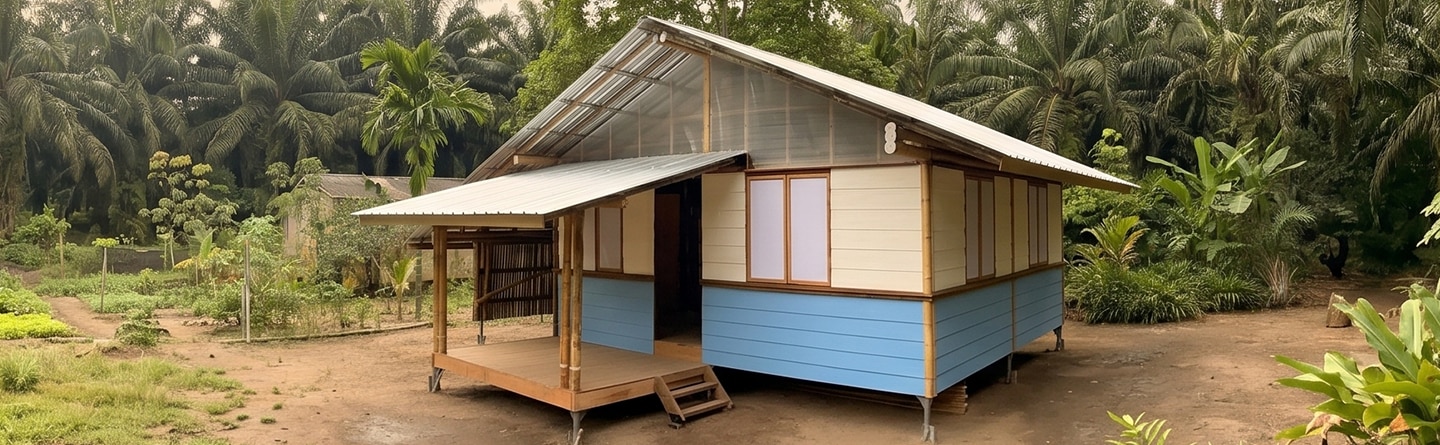
Below, we share the impact* of several grantees around the world who are constructing safe and stable homes for the communities they serve. Their approaches prioritize locally-adapted solutions, including using regional materials like bamboo and leveraging traditional building techniques. Beyond the physical homes, these organizations also actively engage with the community throughout the building process, incorporating local inputs to home designs, and providing construction skills training and volunteer opportunities.
In Costa Rica…
The Challenge: Across some areas of Costa Rica, many families live long-term in unstable and unsafe housing, exposed to risks from storms and floods and with inconsistent access to basic services such as water, sanitation and electricity. These communities also struggle with poverty and are largely dependent on fluctuating agricultural work, which means it is difficult for them to address infrastructure gaps on their own.
The Solution: TECHO is developing new housing solutions in several communities of Costa Rica to address the challenges of shelter, sanitation and energy with a focus on sustainable innovation. With the support of more than 1,500 volunteers, TECHO has begun to construct wooden emergency housing units, which are designed for durability and rapid installation. TECHO is also equipping these homes each with a rainwater harvesting system that collects and filters water for daily use, a dry toilet system that reduces health and environmental risks and solar panels to meet basic energy needs.
So far through the grant period, TECHO has created a safer living environment for over 160 residents, and has so far delivered over 20 water systems, 10 sanitation systems and 10 solar energy kits.
At Citi, we believe that creating sustainable impact starts by working alongside communities and trusted partners like TECHO. This initiative in Costa Rica is part of Citi Foundation’s 2024 Global Innovation Challenge focused on addressing homelessness. Through this effort, we are helping address critical needs in housing, water, sanitation and energy, while strengthening community resilience. We are proud to support solutions that not only improve living conditions today but also create a more sustainable and inclusive future for the families we serve."
In Côte d'Ivoire…
The Challenge: In rural areas of Côte d'Ivoire, approximately 90% of households live in dwellings that are unsuitable for the local climate and are vulnerable to damage from fires, weather and structural failure.
The Approach: Association la Voûte Nubienne is using a 3,000-year old construction technique, adapted to modern climate and economic conditions, to deliver durable housing for low-income communities in northern Côte d'Ivoire. The technique exclusively uses local materials, such as adobe bricks and wild stone. The project also offers opportunities for economic growth and skills development and has trained 45 local masons. Association la Voûte Nubienne has engaged over 1,100 people, including local community members, traditional and administrative authorities and other community-based organizations, to raise awareness of this eco-friendly construction as a solution to housing challenges and its socioeconomic impacts.
So far through the grant period, Association la Voûte Nubienne has provided over 20 of these innovative homes to families.
In Ecuador…
The Challenge: Many communities in Ecuador’s coastal regions face housing insecurity driven by a combination of factors. These include extreme poverty, particularly in tourism-dependent areas impacted by COVID-19, as well as risks from natural disasters and increasing violence from organized crime. In communities across the coastal province of Esmeraldas, over 50% of the population lives in poverty, only 65% of the population has access to an intermittent water supply and less than 2% is connected to sewage systems.
The Approach: Fundación Raíz delivers pre-fabricated housing for low-income families in the Esmeralda province using bamboo, a locally abundant resource, as the main construction material. This initiative couples rapid housing delivery with vocational training, entrepreneurship support and strong community engagement, involving residents directly in construction to build skills and ownership. Each home provides a living space of 45 square meters, with full sanitation and secure water access. These homes can boost the value of the land from $2,500 to $15,000, helping households, mostly led by women, build assets and set up future financial security.
So far through the grant period, Fundación Raíz has delivered over 60 bamboo homes to women and their families living in extreme poverty, providing secure housing for 120 people.
Since the devastating 2016 earthquake in Ecuador, the work of Fundación Raíz has been truly inspiring. With the bamboo homes and beyond, the organization has forged an integrated development ecosystem that is transforming lives. Their holistic approach, spanning clean water, health, education, economic opportunities and climate resilience, positions them as an example of sustainable impact and a model for social transformation in the region. We are immensely proud to support this project through the Citi Foundation, as it is building a stronger future for the community."
In Malaysia…
The Challenge: Many indigenous communities in the country live long-term in unstable or overcrowded homes and are at risk of displacement and homelessness. As they increasingly integrate with modern economies, they face a mismatch between their traditional skills and the demands of the modern workforce, leading to reliance on low-paying and volatile jobs. This means that they are unable to spend the time and resources needed to build homes using traditional materials and methods, nor are they able to afford the cost of modern housing.
The Approach: EPIC Society is addressing the housing needs of indigenous communities across Peninsular Malaysia with an innovative and sustainable house model, that can be constructed in three days. EPIC designs the homes with community participation, to ensure that these modular homes remain culturally relevant, safe and adaptable. This also empowers families to customize and enhance them over time. These modular homes are built with the support of volunteers, who through this process have formed strong relationships with the indigenous communities, establishing support networks that sustain long-term development.
So far through the grant period, EPIC has provided safe shelter with its original modular home design to over 110 families, benefitting over 680 individuals. To scale this model, EPIC is using bamboo, a traditional building material, and treating it with modern techniques to increase durability. Using bamboo means EPIC and the indigenous communities are able to utilize local expertise, reduce construction time and costs and support a more sustainable construction of homes. This approach also enables community members to update their skills in integrating bamboo alongside modern construction practices, opening up potential economic opportunities for indigenous communities to supplement their income by participating in the bamboo supply chain.
Over the next several months, EPIC will continue to test its capacity to scale these bamboo homes as a viable replacement to its original steel-based modular home design, partnering with a village to serve as a pilot and flagship model for wider adoption.
I am proud that Epic Society is pioneering the construction of bamboo homes to address the lack of safe housing amongst the Orang Asli indigenous community. By embracing eco-friendly materials and innovative design, the homes built by Epic Society represent a leap forward in creating economical and lasting solutions.”
*All impact metrics from grantee program are self-reported.