
KEY TAKEAWAYS
- Physical AI is at an inflection point for industrial markets, marked by abundant capital, maturing technology and a diversifying ecosystem
- While humanoid robots have attracted ample attention, this form factor may not be ideal for many Physical AI applications, with battery power and manual dexterity among the challenges
- Warehouse automation is seeing a transition from rigid Automated Guided Vehicles to flexible Autonomous Mobile Robots, but the future of this competition is less about robotic hardware than about the software ecosystem orchestrating that hardware
In a new Super-Sector Analysis from Citi Research, Martin Wilkie and a team of analysts explore the rise of Physical AI — defined as any physical process learning from and applying AI — for industrial markets. We see Physical AI as at an inflection point, with abundant capital, maturing technology and a diversifying ecosystem. AI-enabled edge devices (those at the “edge” of a network as opposed to the central data center or cloud) could see growth in double-digit percentages, as could design and simulation software.
Overall, we see adoption of Physical AI adding percentage growth in the mid-single digits to annual customer capex growth as capital replaces labor, with additional growth fueled by M&A in software and connected hardware. Similar to how Large Language Models (LLMs) need huge amounts of text, industrial AI needs industrial data, of both real-world and simulated varieties. Industrial companies’ large data-gathering physical installed bases and domain-specific know-how loom as both potential key enablers of adoption and moats against disruption.
The growth of networked machines that can connect to the Internet, aka the “Internet of Things,” has already augmented on-device intelligence for industrial products, but we now think the next driver will be AI, as featured in product and process design as well as in edge intelligence. Emerging use cases for industrials include preventative maintenance, product design and operations monitoring.
In recent years, AI investment for industrial names has been dominated by the impact of Generative AI (GenAI) and LLMs on data centers and related infrastructure. Physical AI is different in that it’s domain specific, requiring separate adoption by end markets that each have unique requirements. That means spending patterns will be defined not by hyperscalers’ capex plans, but by the pace of adoption in each end market.
We see three pillars of success for industrial companies: digital twin models (which are virtual representations of physical processes), real-world data gathering through edge devices, and simulation. We’re at the beginning of this journey, as development of the technology is nascent and the industrial cycle will play a role. But companies are already preparing for what’s coming, and we expect investment to continue to pivot to Physical AI adoption.
To illustrate the opportunity, there are some 4 million industrial robots installed globally, with penetration varying enormously by region and industry. If such robots displace 30% of manufacturing tasks over the next decade (running at three shifts a day and doubling human productivity), the installed base will grow to almost 30 million in 10 years, a compound annual growth rate (CAGR) above 20%. That’s almost three times the growth rate predicted by the International Federation of Robotics.
We also note that increased adoption of AI arguably tilts spending from labor to capital investment; in the factory P&L, employee cost is replaced by depreciation. We estimate the related capex requirements could augment capex growth by mid-single digits.
Phases of AI adoption
We see several phases of AI adoption. GenAI is most prevalent, used in industry to combine “knowledge” (such as service documentation) and data, and we see GenAI primarily as an efficiency tool. Agentic AI, with AI decision-making in industrial applications, is also emerging for specific tasks, but adoption is very early-stage, including in areas such as purchasing. “Digital twin” technology and software-defined automation (where AI increasingly drives product and process design) are arguably the areas offering the biggest potential for both disruption and benefits.
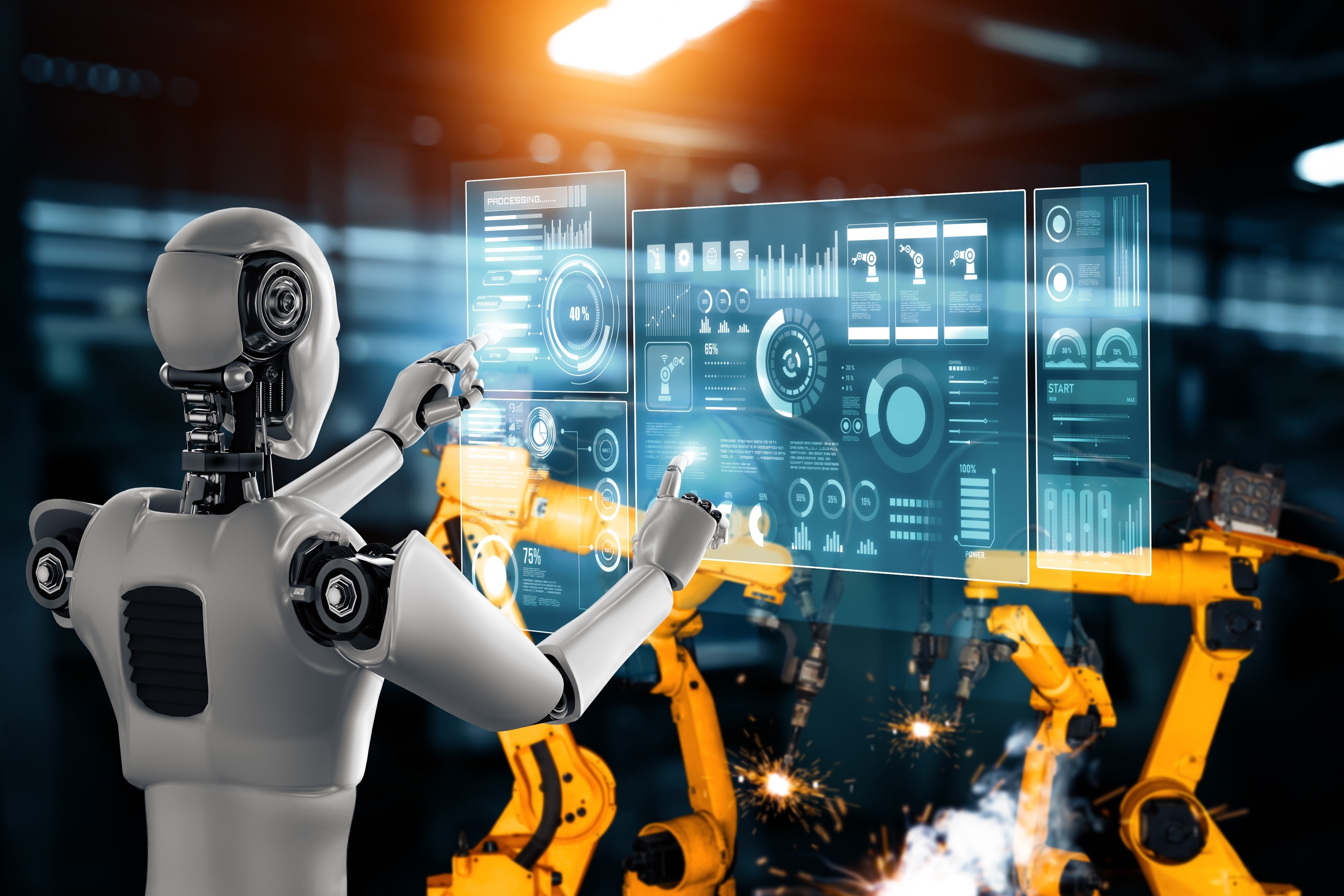
Physical AI is often equated with humanoid robots, but the market is larger than that: NVIDIA, for example, divides AI-capable robots into three categories: agentic AI (knowledge robots), generalist robots (including humanoid forms) and transportation (such as autonomous vehicles). We focus on generalist robots, specifically in factory and warehouse automation. Humanoid robots will be an important category but won’t displace many specialized robotic form factors, which can be faster or more powerful in specific applications.
Even for data software, the industrial installed base and related domain experience matter; industrial software platforms benefit enormously from “equipment on the ground” — controllers, sensors, motors and other devices well positioned to collect data in order to optimize equipment and streamline processes. These connected products arguably formed the largest barriers to entry for newcomers to the industrial Internet of Things, and we think this will also be the case for Physical AI.
Use cases
Simulation is a key pillar of the “simulation, training, edge” framework to drive penetration of Physical AI, especially in product and process design. Product design already relies heavily on software to simulate everything from drag coefficients to load-bearing capabilities, and AI design software can iterate toward a design that’s optimized but within the parameters. Simulation already offers efficiency gains over real-world testing, with more such gains expected: For instance, teaching a robot using real-world data is painfully show, but using synthetic data can accelerate this.
When discussing industrial robots, humanoid form factors have attracted a lot of attention, but our impression is that intelligent robotic arms with dedicated end-of-arm effectors are optimal in more than 90% of manufacturing cases, pointing to significant adoption potential. Over time humanoids could offer autonomous versatility, but in the near term we see intelligent single-arm robots integrated with dedicated process know-how as the preferred form factor. Integrating intelligence and AI will be the next key technology step, with ABB Group seeing pick-and-place applications becoming more autonomous and versatile first, with potential differentiation in software, high motion accuracy, high-speed performance and integration tools.
Simulation, training and edge represent the “three computers” needed in industrial AI, and edge control will need to evolve alongside the assets. At its most basic, industrial automation is sensing (data gathering), intelligence (decision making) and control (instructions). Most industrial processes rely on embedded software in logic controllers or distributed control systems as the intelligence, which has been coded in advance. AI can evolve this to optimize decision-making in real time.
Humanoid robot challenges
Physical AI is simultaneously the key and the main obstacle to developing humanoid robots because integrated advanced AI with complex hardware creates significant hurdles to real-time performance, efficiency and safety. Unlike software-only AI, Physical AI must directly perceive and interact with the unpredictable real world, and without excessive latency.
Building Physical AI requires repetitive training and data collections, which can be done through simulated methods, real-world ones or a combination of the two. We see more humanoid-robot companies relying on simulated methods for such training, as simulated methods are far more time-efficient than real-world ones.
Many humanoid-robot companies are focusing on industrial applications, as factory jobs are mostly well-defined tasks such as moving, stacking or sorting objects. An issue that’s generated considerable debate is whether a humanoid robot needs to be equipped with two legs. This is considered the optimal form for a variety of workplace setups, but maintaining balance consumes significant battery power. This has led to more humanoid-robot companies in China introducing wheel-based versions of their products.
Another issue is the design of dexterous hands. Chinese humanoid-robot makers equip their robots with suckers or three-finger hands, since these are able to handle existing tasks that humanoid robots are trained to carry out.
Vision and sensing
As the Physical AI landscape evolves, we see machine vision playing a critical role in further driving efficiency on factory floors and enhancing product quality through assessments made on the assembly line. We also think machine vision will be increasingly essential in collecting real-time factory data, which can be utilized to optimize overall operational productivity. Machine vision is becoming more mainstream, with such systems used for applications including visual inspection, defect detection, process control and sorting.
AI has helped spur a shift from rule-based machine vision to AI-powered inspection, which has allowed machine vision to handle tasks that previously required human inspectors. For instance, cosmetic defects can be challenging for rule-based machine vision to detect, but AI-powered machine-vision systems learn autonomously by analyzing multiple examples of defects, interpreting data, learning from patterns and making decisions. Machine vision also allows companies to better comply with regulations and enhance worker safety on the factory floor.
China, AGVs and AMRs
We think the warehouse-automation market is at a critical inflection point, transitioning from rigid, fixed-path Automated Guided Vehicles (AGVs) to intelligent, flexible Autonomous Mobile Robots (AMRs). This shift has been propelled by the rapid growth of e-commerce, critical labor shortages, and the strategic need for supply-chain resilience.
We think the total addressable market for warehouse-automation systems will increase by ~11% CAGR to some $112 billion in 2029, and one IPO prospectus leads us to expect about 20% of this total addressable market to fall into AGVs and AMRs.
China’s national strategies have provided a powerful impetus for the development of intelligent logistics and robotics, creating a uniquely favorable environment for domestic companies. Policy support extends beyond production subsidies to the more ambitious goal of creating an entire industrial ecosystem. This state-led industrial strategy provides a significant long-term advantage over competitors in nations lacking a coordinated industrial policy, and its success is already evident: In 2024, Chinese AMR solution providers accounted for about half of the global market share. This has created a virtuous cycle, with state support ultimately driving technological maturity and global expansion.
But significant barriers to adoption of AMRs exist. These include high upfront capital costs, complex integration with legacy systems, and a critical labor-skills gap. One major technical challenge is integrating AMR systems with existing Warehouse Management Systems (WMS) and Enterprise Resource Planning software. A critical issue is the speed mismatch: Robots operate at millisecond-level speeds while many legacy WMS platforms lack real-time processing capabilities. Automation also requires a fundamental shift in the workforce from manual labor to technical roles involving robotic systems’ operation and maintenance.
We think the global AMR market could surge 33% to some $22 billion in 2029, with the market continuing to bifurcate. AGVs will remain relevant for simple, repetitive, point-to-point transport tasks in stable manufacturing environments, but the high-growth, high-margin opportunities will be concentrated in dynamic, complex environments such as e-commerce fulfillment, with such environments demanding the flexibility and intelligence offered by AMRs.
We see the future of competition less about robotic hardware than about the software ecosystem orchestrating that hardware, and we think the long-term winners will be the companies that master the software, AI and integration complexities of modern logistics. AMR pure plays are best positioned to lead the industry into its next phase, thanks to software-native DNA and their proven success in the most demanding fulfillment environments. The key strategic question for incumbents is whether they can make a successful transition from manufacturing hardware to providing integrated software and solutions before the technology gap becomes insurmountable.
Our new report, Embodied Intelligence: The Rise of Physical AI, also discusses stock implications of these trends. It’s available in full to existing Citi Research clients here.