
Global Economic Outlook & Strategy

2024's global growth looks like it will slow only modestly from last year, but downside risks have intensified of late. Such risks, coupled with more favorable inflation data, have opened the door for a full-blown central-bank easing cycle that's likely to gain steam in the months ahead. We explore what may lie ahead in a new report.
In a new Citi Research report, a team led by Nathan Sheets looks at what may lie ahead for the global economy, from forecasts of growth and inflation to central bank policies. We see the global economy as likely to register annual growth of 2.4% this year, down only modestly from 2.7% in 2023. In a sign of economic activity’s continuing resilience, our forecast has risen by more than half a percentage point since January.
Of late, however, downside risks have intensified, with data for several major economies falling short of expectations. For the U.S., recent weeks’ data have been the softest relative to expectations in roughly two years; for the euro area and China, the shortfall is the largest since mid-2023. An additional challenge has come from an uptick in geopolitical tensions; while energy markets seem to consider it unlikely that a conflict will limit physical oil supplies, we note that such an outcome would act as a supply shock for the global economy, lowering growth and boosting inflation.

(Left) Evolution of Citi Global Growth Forecast
This line graph presents Euro-Area "Soft" Data from January 2021 to July 2024. It includes Manufacturing PMI (dark blue), Services PMI (light blue), and Sentix: Overall Economic Index (red, plotted on a separate y-axis). The x-axis represents the timeframe, the left y-axis ranges from 40 to 65 (representing expansion above 50), and the right y-axis (for Sentix) ranges from -40 to 60.
Visual Presentation
The 2023 projection starts high, dips mid-2023, and then slowly recovers. The 2024 projection starts lower, declines gradually, and levels off. The 2025 projection begins lowest and steadily increases.
Key Observations/Trends
A downward trend is seen in 2023 and 2024 projections compared to early 2022 estimates. However, the 2025 projection suggests anticipated growth.
Source:
Citi Research
(Right) Growth Forecast for 2024 (Change Since Sept '23)
This line graph charts China's Real-Time Activity Index (dark blue) and Retail Sales Volume (light blue) from June 2021 to June 2024. The x-axis represents the timeframe, the left y-axis ranges from 60 to 140 (indexed to 2019=100), and the right y-axis (for Retail Sales Volume) shows the year-over-year percentage change (-20% to 20%).
Visual Presentation/Trends:
The United States shows a steady increase. The Euro Area has a more gradual increase. China's forecast increases initially and then levels off. The UK experiences a small increase.
Source:
Citi Research
Despite downside risks and headwinds, global PMIs have held up well through July, with few if any signs of a sharp slowdown. At the same time, global inflation has continued to ease. Global headline inflation is now below 2.5%, though services inflation remains high. But we think services inflation will keep grinding lower as growth moderates and labor markets loosen further. While the “last mile” in the inflation battle may still pose challenges, we think the upside risks to global inflation look less pronounced than they have for the last few years.
Economic developments
The U.S. remains central to the global outlook. Recession fears hit fever pitch earlier this month, but such worries have moderated of late with additional readings painting a more resilient economic picture. The arguments for a recession are historical: Past episodes of high inflation and wage growth alongside tight labor markets have typically led to periods of negative economic growth and rising unemployment. But there are also strong arguments in favor of a soft landing. Our bottom line is that recent market gyrations reflect heightened uncertainties about whether or not a recession is brewing. A recession is our base case, but data in upcoming weeks will be critical in assessing the U.S. economy’s underlying strength.
For the euro area, second-quarter GDP growth came in better than expected, but higher-frequency data may be signaling a loss of momentum. While data still point to modest growth this year, we see risks as increasingly tilted to the downside. In China, many indicators continue to highlight cyclical softness, but we expect to see additional fiscal stimulus and further monetary easing in the year’s second half, and think growth just below China’s official 5% target is still achievable. And while the global manufacturing recovery still looks lackluster, indicators for several emerging-markets Asian economies have shown strength.
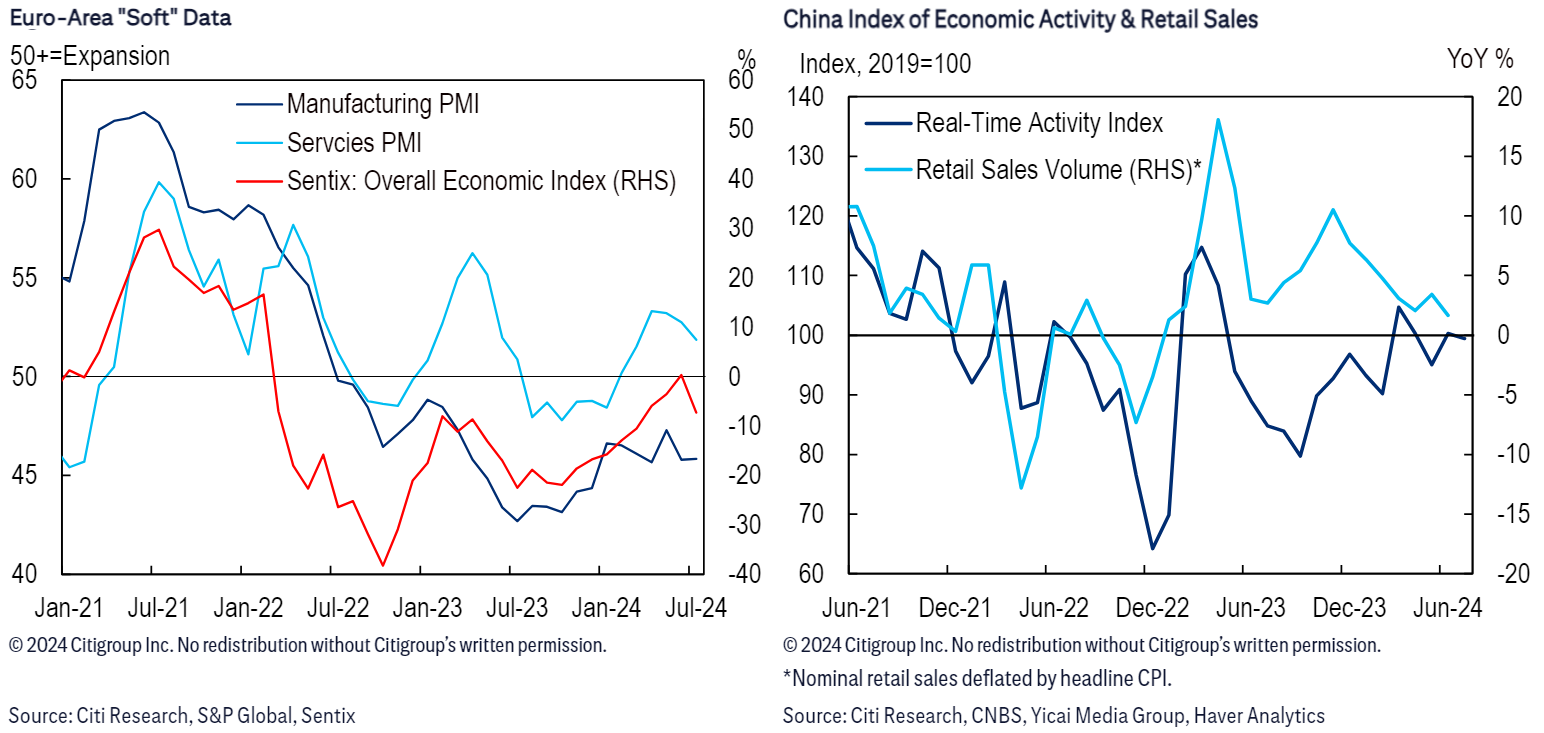
(Left) Euro-Area "Soft" Data (Jan 2021 - Jul 2024)
This stacked bar chart illustrates the growth of the Green, Social, Sustainability, and Sustainability-Linked Bond Market from 2013 to 2022. The total market size, represented by the combined height of each year's bar, has grown from a negligible amount in 2013 to over $2.8 trillion by 2022.
Visual Presentation/Trends:
The PMIs generally fluctuate above 50, indicating expansion. The Sentix index shows greater volatility, including periods below zero.
Source:
Citi Research, S&P Global, Sentix
(Right) China Index of Economic Activity & Retail Sales (Jun 2021 - Jun 2024)
This line graph charts China's Real-Time Activity Index (dark blue) and Retail Sales Volume (light blue) from June 2021 to June 2024. The x-axis represents the timeframe, the left y-axis ranges from 60 to 140 (indexed to 2019=100), and the right y-axis (for Retail Sales Volume) shows the year-over-year percentage change (-20% to 20%).
Visual Presentation/Trends:
The Real-Time Activity Index shows fluctuations, while Retail Sales Volume experiences significant volatility, including negative growth periods.
*Nominal retail sales deflated by headline CPI.
Source:
Citi Research, CNBS, Yicai Media Group, Haver Analytics
What’s ahead for central banks?
A combination of more favorable inflation dynamics and worries about downside risks to activity has opened the door for central banks to engage in a full-blown global easing cycle, which we expect to gain steam in the months ahead.
Central banks are seeing more scope to reduce the restrictiveness of their policies. In recent weeks, the UK, Canada and New Zealand have all cut rates; all told, the cutting cycle over the last few months is the largest seen over the last 20 years aside from global recessions. It’s our view that central banks are just getting started: We expect the Fed to deliver a first rate cut in September, with the European Central Bank resuming easing as well. Central banks for many major developed markets are then likely to ease in lockstep through the rest of 2024 and much of 2025.
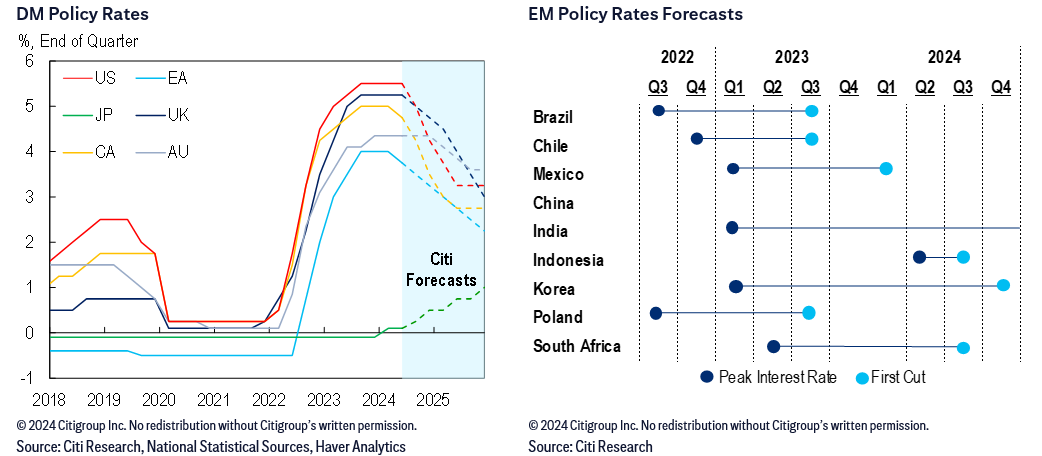
(Left) DM Policy Rates (2018-2025)
This line graph shows DM Policy Rates (%, end of quarter) from 2018 to 2025 for the US (red), Euro Area (light blue), Japan (Green), UK (dark blue), Canada (orange), and Australia (gold). The x-axis represents the years, and the y-axis shows the percentage range from -1 to 6. Citi forecasts are indicated by dashed lines in a shaded region.
Visual Presentation/Trends:
The graph displays historical rates and projected future rates, with variations across regions. The Citi Forecasts highlight potential rate movements in 2024 and 2025.
Source:
Citi Research, National Statistical Sources, Haver Analytics
(Right) EM Policy Rates Forecasts (Q3 2022 - Q4 2024)
This dot chart presents EM Policy Rates Forecasts from Q3 2022 to Q4 2024 for several countries. Dark blue dots represent peak interest rates, and light blue dots represent the first rate cuts. The x-axis shows the quarters and years, and the countries are listed on the y-axis. A line connects the peak interest rate to the first rate cut for each country.
Source:
Citi Research
Australia and Japan remain outliers. We expect Australia to remain on hold this year and deliver its first cut in February, though risks remain tilted toward a later start date. Japan recently raised rates, and we expect further hikes in this cycle.
Many emerging markets began easing relatively early, but their easing cycles have been gradual, with less scope for cuts than anticipated in some cases. As developed-markets rate cuts gain momentum, emerging markets may be able to begin a new phase of cutting cycles. Moreover, we note a growing debate over whether the Fed should start its cutting cycle with cuts of 50 basis points or more; such a jumbo move could open the flood gates for faster cutting cycles elsewhere.
Even so, central banks have fought hard to wrestle inflation to within a stone’s throw of their targets. Unless there’s a further slowdown, we think they may be hesitant to ease policy rapidly and so run the risk of jeopardizing their hard-won gains.
Our new report, Global Economic Outlook & Strategy: Global Resilience — The Plot Thickens, also includes views of equity strategy and other assets. It’s available in full to existing Citi Research clients here.