Markets Edition: “King of the North”— Market Implications of Andy Burnham

KEY TAKEAWAYS
- Political Shift and Leadership: Andy Burnham's by-election victory positions him as a strong contender for Prime Minister, indicating a significant reshaping of the UK political landscape. An orderly handover is expected within the Labour Party by mid-to-late summer.
- Economic Policy Uncertainty: A Burnham premiership faces hard choices with no firm policy platform yet. Key areas of focus may include public infrastructure, transport, and potential nationalization of utilities, though specific details remain to be seen.
- Market Implications: A weaker pound and slightly higher interest rates are likely. The FTSE 250 is expected to underperform the FTSE 100 in a rising yield environment, with financials and energy sectors potentially benefiting.
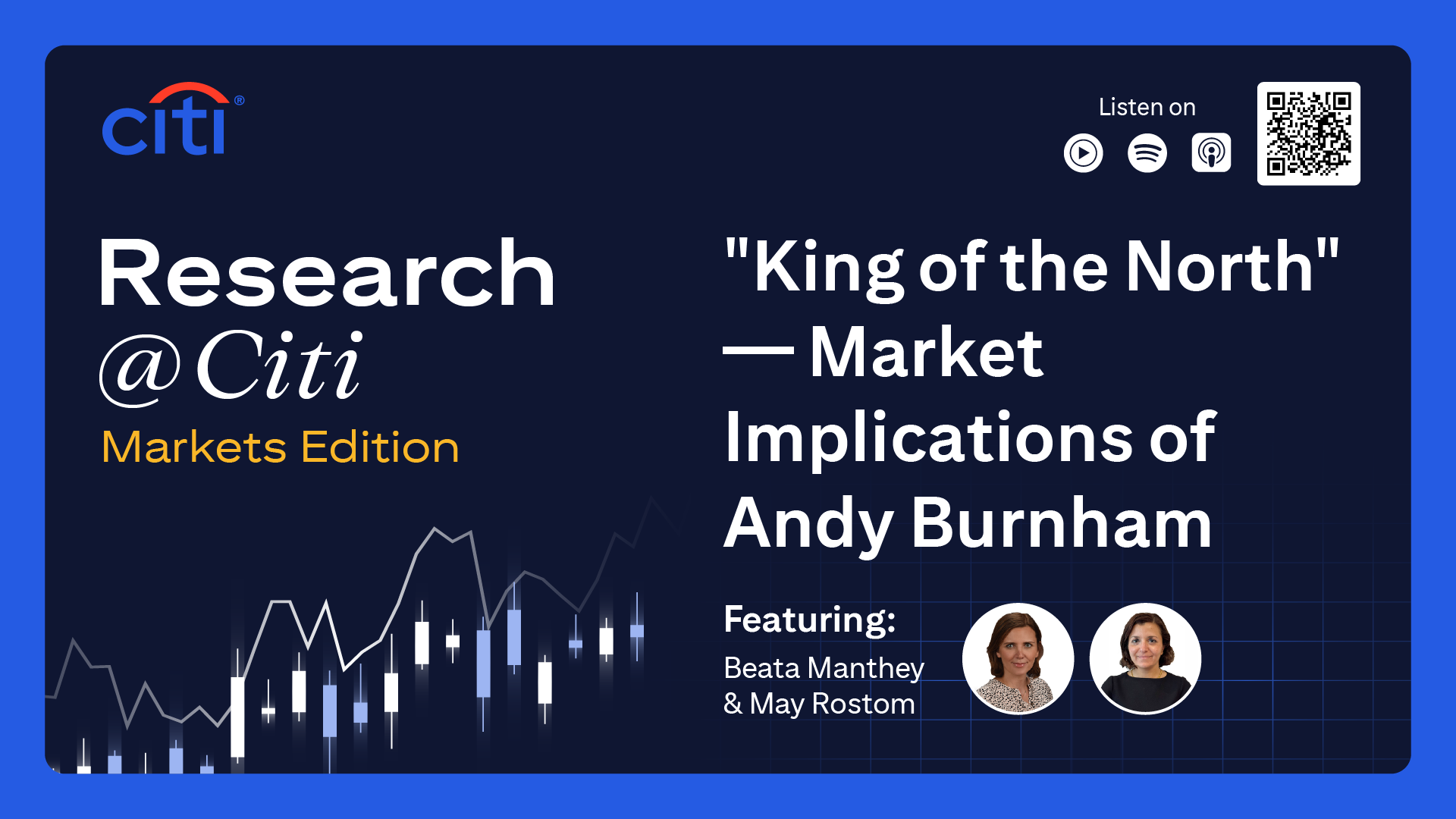
Beata Manthey and May Rostom discuss the reshaped UK political landscape now that Keir Starmer has resigned as prime minister and Andy Burnham is the clear front-runner to lead the country. The implications are far-reaching, ranging from the stability of the transition to the direction of the economy, rates, FX and equities.
This podcast contains thematic content and is not intended to be investment research. Nor does it constitute financial, economic, legal, tax or accounting advice. This podcast is provided for information purposes only and does not constitute an offer or solicitation to purchase or sell any financial instruments. The contents of this podcast are not based on your individual circumstances and should not be relied upon as an assessment of suitability for you of a particular product, security, or transaction. The information in this podcast is based on generally available information and, although obtained from sources believed by Citi to be reliable, its accuracy and completeness are not guaranteed. Past performance is not a guarantee or indication of future results. This podcast may not be copied or distributed, in whole or in part, without the express written consent of Citi. © 2026 Citigroup Global Markets Inc. Member SIPC. All rights reserved. Citi and Citi and Arc Design are trademarks and service marks of Citigroup Inc. or its affiliates and are used and registered throughout the world.
Beata Manthey, Head of European Equity Strategy
Beata Manthey is Head of European Equity Strategy in Citi Research. She joined Citi in 2007 as a Global Equity Strategist. Beata is part of a team that focuses on broader equity market issues. Prior to joining Citi, she worked at the European Bank for Reconstruction & Development.

May Rostom, Chief UK Economist
May Rostom is Citi’s Chief UK Economist, based in the London office. Before joining Citi in April 2026, May worked at the Bank of England, where she held several positions in monetary policy and financial stability with increasing levels of seniority. She brings deep expertise in the UK economy, with particular strengths in labour markets, household consumption, productivity, and the transmission of monetary policy.