
MEA Treasury: A shift in how transformation is delivered

Corporate treasury functions across the Middle East and Africa (MEA) are entering a decisive phase of transformation. Faced with volatile markets, fragmented banking ecosystems, and increasing pressure to support strategic decision-making, while also operating within economies shaped by strong commodity flows and rapidly evolving financial ecosystems, treasurers are being asked to do more than ever before.
Intro: A Region at an Inflection Point
Corporate treasury functions across the Middle East and Africa (MEA) are entering a decisive phase of transformation. Faced with volatile markets, fragmented banking ecosystems, and increasing pressure to support strategic decision-making, while also operating within economies shaped by strong commodity flows and rapidly evolving financial ecosystems, treasurers are being asked to do more than ever before.
Yet the result of a Citi survey published in April 2026 shed new light on how the function is responding. The survey captures the perspectives of over 900 treasury and finance professionals, providing a solid and representative sample of decision makers from across the MEA region giving us a robust snapshot of how decision- makers are prioritizing the next phase of treasury’s evolution.
Treasury teams are clearly aligning around outcomes that depend on more advanced capabilities, real-time visibility, increasingly dynamic liquidity management, and more tailored financial solutions for customers and suppliers. Yet the technologies traditionally associated with enabling these outcomes, particularly AI and broader treasury infrastructure, remain low on the list of internal investment priorities.
Rather than a contradiction, this points to a more deliberate operating model emerging:
The logic behind this shift becomes clearer when we return to the core of the treasury function and the fundamentals that continue to define its priorities.
1. Back to Basics: A Function Anchored in Fundamentals
The internal focus of MEA treasury teams is unambiguous. The survey shows that: cash visibility and forecasting (53.23%) and liquidity optimization (50.32%) are the dominant priorities.
| Cash forecasting and liquidity optimization remain core treasury focus |
|---|
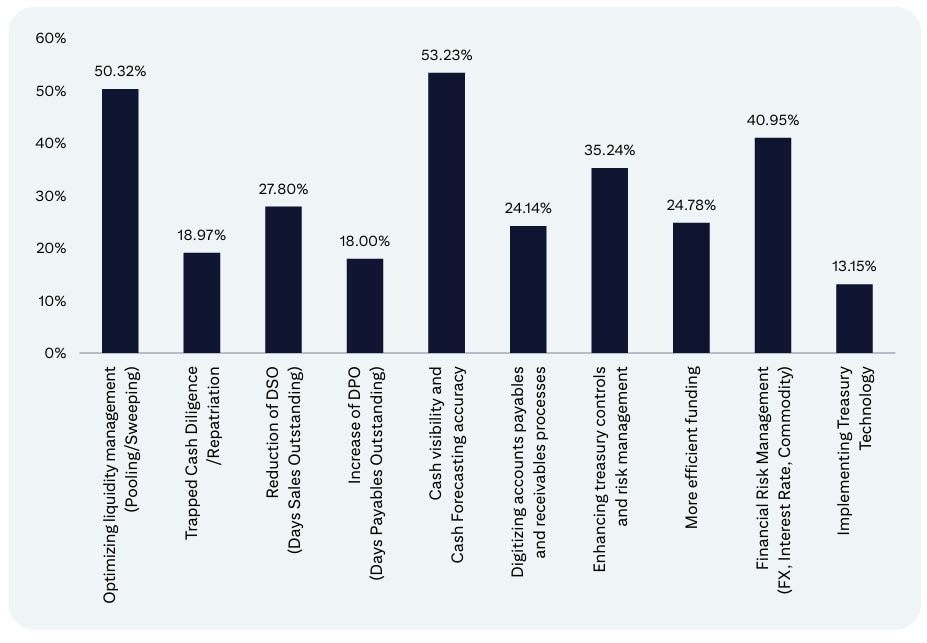 |
Sources: MEA Treasury Priorities Survey 2026 Bar chart showing that optimizing cash liquidity management (according to 50.32% or respondents )and cash visibility and forecasting accuracy (53.23%) are the top two concerns are the top areas of focus for Treasurers. Of lowest concern was implementing treasury technology - with 13.15% of survey respondents citing this. |
This is perhaps unsurprising. These activities represent the ‘bread and butter of treasury’, the core disciplines that underpin the function’s ability to maintain control over cash and liquidity, ensuring the organization can meet its obligations, manage risk, and operate with confidence in uncertain environments.
By contrast, treasury technology implementation ranks last on the list of goals (just 13.15%).
This signals a function still heavily occupied with foundational challenges. In many markets across MEA, structural complexity, whether from currency volatility, regulatory fragmentation, or limited banking interoperability, means that even achieving consistent cash visibility remains a daily operational challenge.
In this context, deprioritizing technology is not resistance. The story is more nuanced and reflects a pragmatic response to the specific challenges in the MEA region. Treasurers are focused on securing visibility and liquidity as immediate imperatives, while increasingly treating the technology required to deliver more advanced capabilities as something that does not necessarily need to be built in-house. This approach is further reinforced by the structure of many treasury teams, typically lean and often operating with constrained investment, making a build model neither practical nor necessary.
If the internal agenda is anchored in the fundamentals of treasury, the external agenda is evolving in a different direction.
2. External Priorities: A strong appetite for customization
While internal priorities remain firmly anchored in treasury’s core fundamentals, external priorities are becoming increasingly dynamic.
Across both customer and supplier engagement, customization emerges as the single most important objective and the survey results tell a compelling story:
Delivering customized financial solutions is the highest scoring treasury priority for optimist the relationship with customers 43.32%
| Personalization is the key treasury priority |
|---|
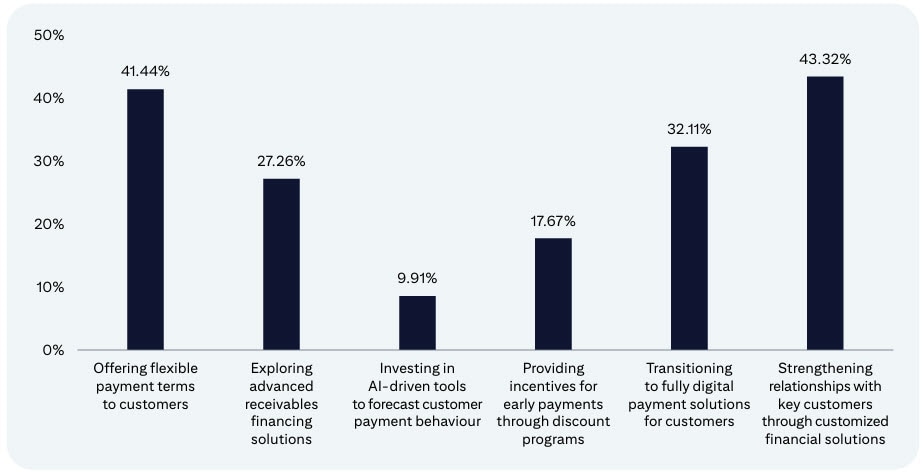 |
Source: MEA Treasury Priorities Survey 2026 Bar chart showing that 43.32% of respondents cited strengthening relationship with key customers through personalization as a key treasury priority. This was the highest number for any category ahead of offering flexible payment terms (41.44%). The lowest percentage of respondents- 9.91% - cited investing in AI tools to forecast customer behavior as a key priority. |
Customization (through tailored financial terms) is also the highest scoring priority for strengthening relationships with key suppliers 46.61%
| Customization through tailored financial terms remains key focus to strengthen customer relation |
|---|
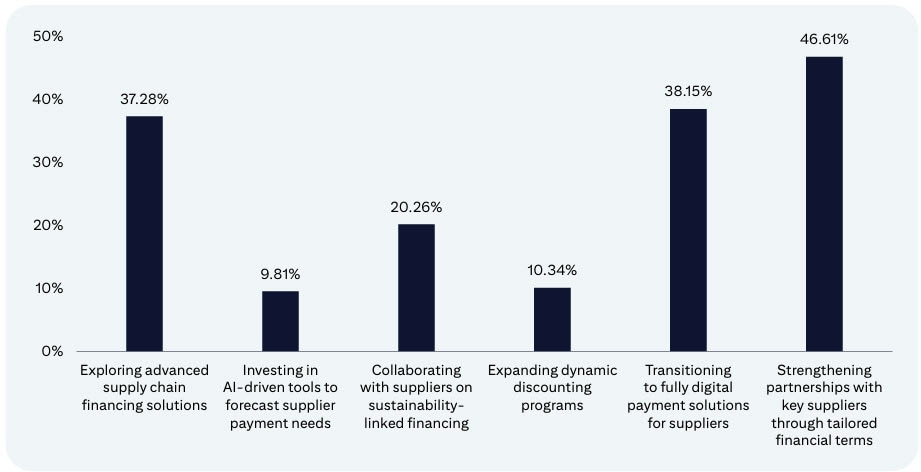 |
Source: MEA Treasury Priorities Survey 2026 Bar chart showing that 46.61% of survey respondents said tailored financial terms with key suppliers is a key priority, ahead of transitioning to fully digital payment suppliers (38.15%) and exploring advanced supply chain financing solutions (37.38%). |
This reflects a broader shift in treasury’s role from a pure control function to a strategic enabler of commercial relationships. Treasurers are expected to support growth by offering differentiated financial solutions, whether through bespoke payment terms, liquidity support, or structured financing arrangements.
However, an important nuance emerges when examining how treasurers plan to deliver this. Only ~10% are investing in AI-driven tools forecasting of customer or supplier behavior despite the accelerating investment in AI and the growing competition among firms to capture its economic value. This suggests that despite growing attention around AI, its deployment in this area of treasury is still at an early stage for most multinational corporates in the region.
This raises a natural question: how will treasurers deliver this shift toward customization and more dynamic decision-making? Isn’t AI the answer?
3. AI in treasury: trust comes first
The very capabilities that treasurers rank highest, customization, personalization, dynamic financial structuring, are precisely those most effectively enabled by AI and advanced analytics.
Yet as the survey results show adoption remains limited: Nearly half (49.41%) of respondents are not exploring AI solutions and have no plans to explore or implement AI solutions. A further 36.06% are only in early consideration stages.
| AI adoption in treasury remains nascent |
|---|
 |
Source: MEA Treasury Priorities Survey 2026 Pie chart showing that almost half of respondents said they have no plans to explore of implement AI solutions at the moment. More than 36% of respondents have some plans to explore and implement AI solutions. And 14.53 % said they are implementing AI solutions now. |
This should not be interpreted as a definitive position. Rather, it reflects a point in time. As AI capabilities continue to evolve and demonstrate tangible value, its adoption within treasury functions is likely to accelerate. What is shaping modest adoption today is not resistance, rather the fear that not all the conditions of trust are mature enough to give them comfort in deploying technology. Treasurers operate in an environment where clarity, accountability, and control are paramount. Being able to explain a decision is as important as making it. In this context, explainability becomes a prerequisite for adoption.
“Treasury teams don't fear AI. They fear being wrong and not knowing why. Give them explainability, and adoption will follow.” Rizwan Shaikh Corporate Bank and Services Head, Middle East & Africa
At the same time, there is a more foundational constraint. AI cannot compensate for fragmented data. As a result, many treasury teams recognize a simple reality: intelligence cannot be layered onto unstable data foundations. Data must first be standardised, integrated, and trusted before more advanced capabilities can be fully realized.
This is shaping a more deliberate adoption path: first, clean and stabilize the data environment and then, introduce intelligence in a controlled, explainable way.
Alongside this, another shift is becoming increasingly visible, one that aligns closely with the broader theme emerging from the survey.
Rather than building AI capabilities internally, treasury teams are increasingly adopting a more embedded approach. For many, AI will not arrive as a standalone initiative or a dedicated transformation program. Instead, it will be accessed as a standard feature within the platforms they already use, whether through Treasury Management Systems (TMS), banking platforms, or ERP solutions that are progressively integrating AI capabilities.
In this model, intelligence is not built or even actively “implemented” it is consumed as part of the operating environment. Adoption becomes less about making a discrete investment decision, and more about the natural evolution of the tools treasury already relies on.
AI, in this sense, is not being delayed it is being absorbed indirectly, embedded within broader technological ecosystems that provide both capability and control.
4. Where AI Resonates: back to treasury fundamentals
Despite the measured pace of adoption, the survey reveals an important nuance: AI is not absent, it is being applied selectively, and in ways that reinforce treasury’s foundational priorities.
Where treasurers are engaging with AI, the use cases are closely aligned to the core responsibilities of the function: cash flow forecasting (35.78%) and payment processing efficiency (30.28%).
| Areas of implemented or interest in implementing AI |
|---|
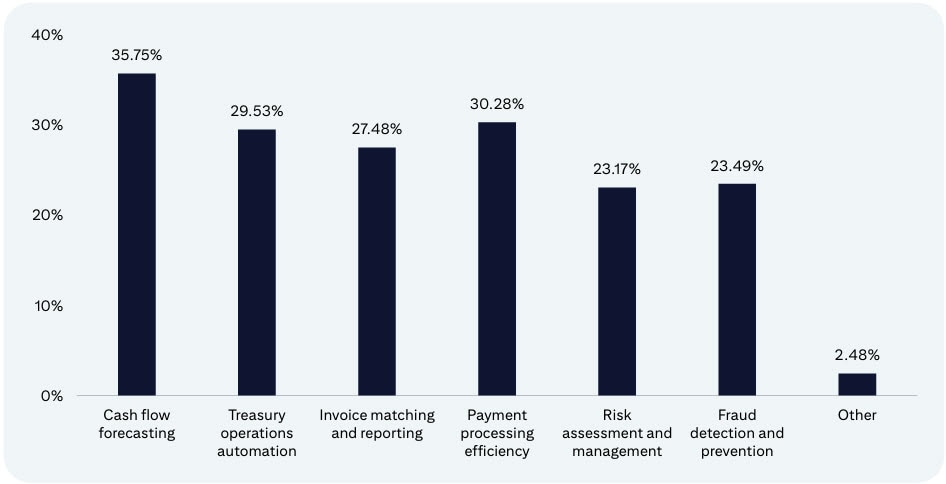 |
Sources: MEA Treasury Priorities Survey 2026 Areas that respondents are interested in implementing Ai include cash flow forecasting (35.75%). More than 20% of respondents cited payment pricing efficiency, treasury operations automation, invoice matching or reporting, fraud detection and prevention and risk assessment and management, respectively. |
This pattern reinforces a broader reality shaping treasury in MEA. The region’s operating environment, characterized by FX volatility, fragmented markets, and varying counter-party risk, places a premium on getting the fundamentals right. In some cases, currency movements of up to 10% in a week and rapidly shifting exposures mean that visibility and control are not just operational goals, but critical risk management priorities.
Against this backdrop, the role of AI becomes more clearly defined: not as a driver of transformation in its own right, but as an enabler of core treasury fundamentals. In other words, where AI is being embraced is where it directly strengthens visibility, liquidity control, and operational reliability, the same fundamentals that anchor treasury’s internal agenda which we discussed above. By contrast, its application remains limited in more outward-facing, relationship-led areas, such as dynamic pricing of payment terms, predictive supplier financing, or customer segmentation, where the benefits, while significant, are longer term and less immediately tied to control.
As treasurers strengthen their data foundations and gain greater control over cash and liquidity, the next logical step is not simply more advanced analytics, but the ability to act on insight instantly. In this context, real-time capability emerges as an extension of control itself, forming a link between visibility, risk management, and execution. The ability to access accurate positions, respond to liquidity needs instantly, and adjust exposures accordingly has a direct impact on financial outcomes. This makes the pathway to real-time treasury both urgent and risk driven.
5. The Real-Time Imperative
| Real-time treasury to scale in near-term |
|---|
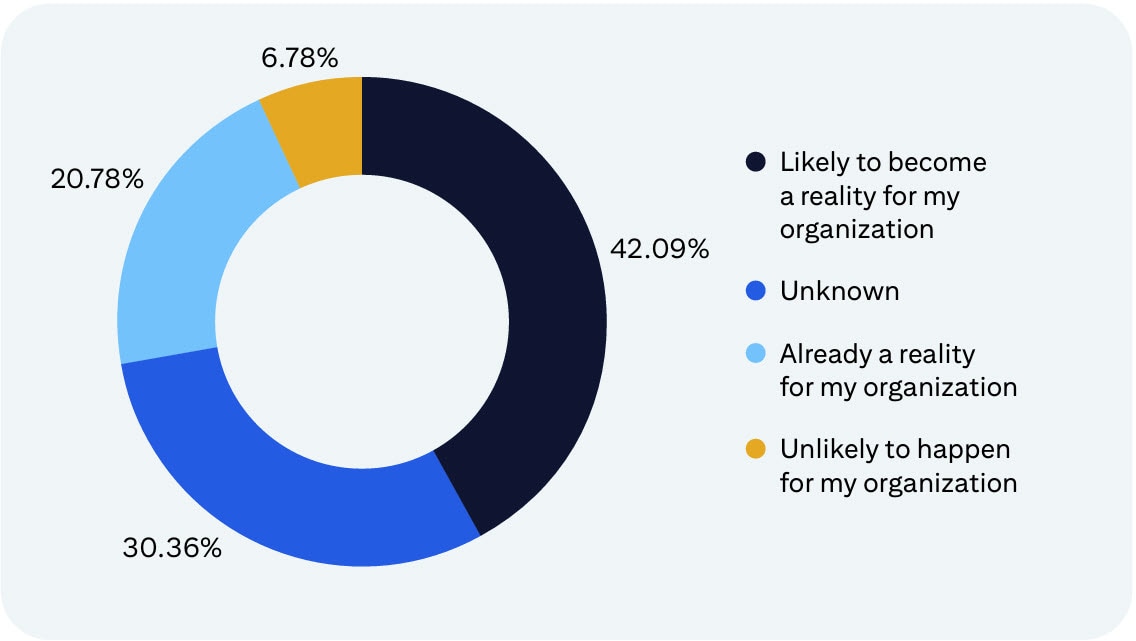 |
Source: MEA Treasury Priorities Survey 2026 Pie chart showing that 42.09 % of respondents said real time treasury was likely to become a reality for their organization in the near term. More than 30% said this was unknown and more than 20% said it was already a reality. Almost 7% said it was unlikely to happen in their organization. |
In a region where counter-party exposure can shift quickly and FX rates can move materially within short periods, real-time treasury is not simply about speed or efficiency, it is fundamental to effective risk management. The ability to access accurate positions, respond to liquidity needs instantly, and adjust exposures dynamically has a direct impact on financial outcomes. In this sense, real-time capability represents a natural extension of control, linking visibility directly to execution.
Beyond risk management, structural shifts across the region are also reinforcing the move toward real-time treasury. Corporates are increasingly evolving toward centralized treasury models and shared service centres, creating a greater need for consolidated, real-time visibility across multiple markets. At the same time, ongoing geopolitical uncertainty are placing renewed pressure on organizations to optimize working capital. Treasury functions are therefore being asked not only to protect liquidity, but to actively unlock and mobilize cash across the organization, further increasing the need for immediacy and precision in decision-making.
“Africa is seeing corporate treasury evolving toward centralized models, shared service centers, and greater operational efficiency. At the same time, companies are under increasing pressure driven by geopolitical uncertainty to maximize working capital and extract every increment of liquidity”
Sheetal Shah Head: Corporate, Commercial & Public Sector Sales, Sub Saharan Africa
Importantly, the push toward real-time is not driven solely by constraint, but also by opportunity. Africa’s traditional strength in commodities (particularly metals and diamonds) and agriculture, complemented by the rapid growth of fintech ecosystems and digital payment infrastructure, are accelerating the adoption of instant payment capabilities across markets. In parallel, demographic trends, most notably one of the fastest-growing and youngest populations globally are reinforcing demand for digital, always-on financial services, further embedding expectations of immediacy into the financial system.
Taken together, these forces are reshaping the treasury operating model. Real-time capability is no longer a standalone aspiration or a purely technological milestone. It is becoming a functional requirement, underpinning risk management, liquidity optimization, and organizational responsiveness.
While the journey remains uneven across markets, the trajectory is clear: real-time treasury will continue to develop through a combination of infrastructure evolution, fintech innovation, and structural demand, positioning it as a key feature of the region’s next phase of treasury transformation.
Conclusion
A Defining Moment for MEA Treasury
The MEA treasury function stands at a critical juncture. It has clarity on its priorities, and a pragmatic approach to how transformation will be delivered. What emerges from the survey is not a gap, but a distinct trajectory. A trajectory shaped by a focus on fundamentals, a preference to access rather than build technology, and a disciplined approach to control and risk.
As this trajectory unfolds, MEA treasury is unlikely to simply converge with global models. Instead, it will continue to evolve in a way that reflects its unique operating environment, one where volatility reinforces discipline, and structural complexity shapes capability. As real-time infrastructure matures and access to embedded intelligence expands, the defining feature of treasury in the region will not be how closely it mirrors other markets, but how effectively it responds to its own.
“MEA treasury won’t look like European treasury in 5 years. It will look like MEA treasury—still as competitive, but in a unique way.” Rizwan Shaikh Corporate Bank and Services Head, Middle East & Africa
Methodology
This survey was conducted by Citi's Services group during June to August 2025. Approx 3500 treasury industry professionals from 1300 sources were contacted. 930 responses were received. Most responses were contributed by individuals in key leadership roles, including Treasurers, Finance Directors, Finance Managers, Chief Financial Officers (CFOs), and Chief Accountants.