
Citi Turns 200: New technologies bring communications revolution

In celebration of Citigroup's 200th Anniversary, we are sharing stories from our rich history here on this blog. The 12th installation below covers how National City Bank embraced new communication technologies. Read the 11th installment on how World War I created career opportunities for women, here.
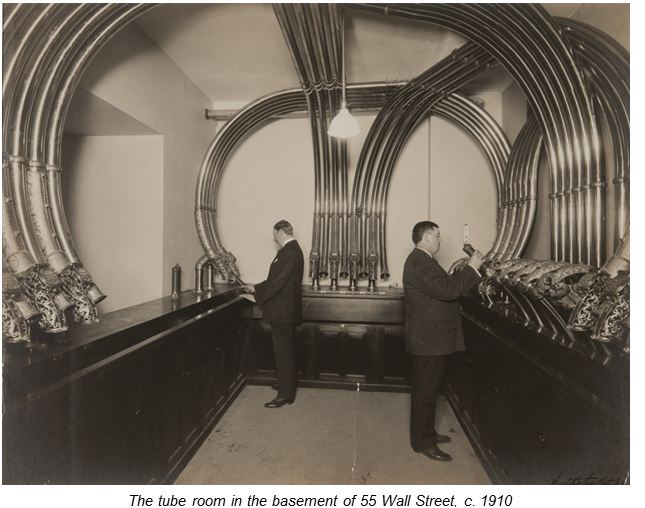
New technologies bring communications revolution
In the early 1920s, National City Bank had one of the largest telephone switchboards of any bank in the world. Of the 12 positions for operators, two were used by the International Banking Corporation and two by the legal firm Shearman & Sterling. National City Bank alone made an average of 40,000 outgoing calls a month, or about 1,600 calls a day. Supervised by Ethel Ketchman and her assistant Anna Buckel, the switchboard opened at 8:00 a.m. and closed at 6:00 p.m., except on Saturdays, when work finished at 3:00 p.m. Sixteen connections were maintained at night and on Sundays and holidays.
In 1931, the bank inaugurated the world's largest private telephone system with 10,000 extensions and positions for 80 operators. It could handle 39,000 outgoing, 59,000 incoming, and 31,000 internal calls a day. The system took 40 men almost six months to install and took up almost an entire floor of the new City Bank Farmers Trust Building, home of the bank's recently acquired affiliate.
Among the innovations was a system for transmitting messages via a network of pneumatic tubes. The tube room was in the basement of 55 Wall Street and could handle up to 1,100 messages a day. Six years later, the bank installed a new pneumatic system that could send 12,000 cartridges a day. As more and more office machinery was being used, the bank set up a machinery repair department with six repairmen. It was initially responsible for more than 600 typewriters, 200 adding machines, and 200 Dictaphones. Once regarded as a toy, the Dictaphone played an important role by the early 1920s, with about 30 Dictaphone operators working in the stenographic department.