
Building Communities Across the Globe with Habitat for Humanity
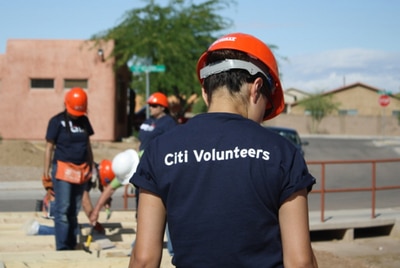
On Global Community Day (June 22), Citi will work with nonprofit organizations to strengthen communities around the world through volunteerism. One of our key partners is Habitat for Humanity. Below, Mike Carscaddon, executive vice president of international field operations at Habitat for Humanity International, talks about the organization's work and partnership with Citi and the Citi Foundation.
Building Communities across the Globe
Habitat for Humanity International has built, rehabilitated, repaired or improved more than 600,000 houses worldwide, providing decent and affordable shelter for more than 3 million people. Recently Builder Magazine named Habitat as the tenth largest homebuilder in the United States.
Since 1999, Citi and the Citi Foundation have helped advance Habitat's mission to build homes, communities and hope by providing technical, financial and volunteer support to expand our programs as well as test new ideas.
In 2004, the Citi Foundation and Habitat began working together to provide a number of services to families in need of adequate shelter. Starting in Latin America, we focused on developing a financial education program that would deliver high-quality training to families who had either applied for or who had been approved as recipients of loans to purchase or improve their homes. Over the past nine years, Habitat has helped improve the financial stability of partner families by providing financial education workshops and customized financial counseling to 15,000 families through its affiliates and microfinance partners in 11 countries.
Citi and the Citi Foundation continues to help Habitat work with market actors, such as local financial institutions, to develop financial products appropriate for the incremental building process pursued by much of the developing world. Through Habitat's influence, now more than 50 local financial institutions offer housing microfinance - a bundle of financial services and construction technical assistance - sustainably serving households through demand-driven market systems. A recent example is in the Asia Pacific region where, with Citi Foundation support, we are currently implementing a multi-country microsavings and financial education initiative designed to help low-income families living in disaster-prone areas save for home improvements.
This work culminated in Habitat's creation of its Center for Innovation in Shelter and Finance (CISF), which is our main initiative to influence market actors to engage in and use best practices to expand access to affordable housing through the market. Citi Foundation's support of the Center's publication "Housing Microfinance: A Product Development Toolkit" led to the highest-attended training at the 2012 SEEP annual meetings.
Below are three ways our approach has helped build communities across the globe:
1. Strong communities through decent housing
In the United States, more than 200 affiliates are engaged in Habitat's Neighborhood Revitalization Initiative, which constructs, repairs and rehabilitates affordable housing with low-income families in markets hit hard by foreclosures. Habitat affiliates are joining residents, nonprofits, businesses, local governments and communities of faith to create and implement a shared vision of revitalization. After Habitat helped revitalize a Winston-Salem, N.C., neighborhood, by working with a host of local public and private partners, crime dropped by 50 percent and drug offenses by 70 percent.
2. Improved local economies
Habitat's local construction efforts positively affect local economies. A study in Dallas, Texas, for example, indicates that for every dollar Dallas Area Habitat for Humanity spends, $3.18 is generated in economic activity. A Habitat development in New York channeled $2 million to local businesses over the course of a project there, and a study by the Center for Business and Economic Research at the University of Tennessee in Knoxville reveals that during fiscal year 2011, each Habitat home built in Tennessee generated 6.24 full-time jobs.
3. Vibrant market-oriented access
Habitat's efforts such as the CISF above have worked to expand opportunities for affordable housing through the market beyond what can be provided through non-profits alone. Citi volunteer support on Habitat for Humanity International's social investment fund for housing in the developing world, the MicroBuild fund, has approved more than $20 million in capital to be used for the construction of homes by low-income households in Tajikistan, Uganda, Lebanon, and Bolivia.
Finally, Habitat for Humanity could not have built its first house, let alone more than 600,000, without support from partners at so many levels, creating lasting partner relationships and networks. Corporate donors and volunteers working hand in hand with families create a meaningful experience for all, and many times lasting bonds emerge. We are pleased that Citi volunteers from across the world - including in the Dominican Republic, Jordan, Canada and the U.S - will be volunteering their time with Habitat programs this month.
Visit www.habitat.org/getinv to learn about Habitat's work around the world and how you can get involved.